← BibliothèqueToutes les vidéos
Tech.Rocks Summit 2023
Generative AI Stakes and perspectives
- Caroline Yap (Managing Director Global AI Business, Google)
Tech.Rocks Summit 2023 · 8 décembre 2023 · 31 min · en anglais
Résumé
Caroline Yap présente la vision de Google sur les grands enjeux de l'IA générative, comme la durabilité, l'approvisionnement en processeurs, la confidentialité des données ou l'ouverture des modèles en open source.
L’essentiel
Caroline Yap (Google) présente la vision de Google Cloud sur l’IA générative en entreprise : préparer ses données, offrir un cadre sûr aux usages des salariés, réduire les hallucinations, avec une démonstration de chatbot et une vidéo de lancement de Gemini.
Pour préparer un premier projet d’IA générative et discuter du cadre à offrir aux équipes qui utilisent déjà ces outils.
Les idées clés
- Préparer le terrain avant l’IA. Selon Caroline Yap, une entreprise qui ne fait pas encore d’automatisation ni d’analytique n’est pas prête pour l’IA : des données non classifiées ne donneront pas les résultats attendus. Elle conseille d’être très précis sur ce que l’on cherche à faire, avec le gain de temps comme premier objectif. à 5:53
- Encadrer des usages qui existent déjà. Comme à l’arrivée des smartphones, les salariés utilisent déjà les outils grand public ; sans moyen sûr, de confiance et privé de les utiliser, l’entreprise risque que ses données sortent. Elle recommande des bacs à sable sécurisés pour que les équipes expérimentent. à 7:57
- Réduire les hallucinations et régler les garde-fous. Elle cite l’humain dans la boucle (un simple pouce levé ou baissé sur un chatbot), et, dans la démonstration, un chatbot qui répond à partir des seules données de l’entreprise, avec l’option de désactiver la réponse générée. Les seuils de sécurité de la plateforme Vertex sont réglables selon le profil de risque de chaque entreprise. à 12:47
Questions pour votre équipe
- Nos données sont-elles assez classifiées et fiables pour alimenter un modèle ?
- Quels outils d’IA générative nos équipes utilisent-elles déjà sans cadre, et quelle alternative sûre leur proposer ?
- Comment recueillir un retour humain sur la qualité des réponses de nos outils ?
L’intervenante travaille chez Google et présente les produits de Google Cloud (Vertex, Gemini, outils d’image) ; elle reconnaît elle-même présenter sa plateforme comme sûre. Les statistiques et exemples clients sont cités sans source ni détail, et le talk date du lancement de Gemini (fin 2023).
Chapitres
Summary
Caroline Yap presents Google's view of the major issues surrounding generative AI, such as sustainability, processor supply, data privacy and the open-sourcing of models.
Thèmes : IA
Transcript complet
Transcription automatique, à relire : les noms propres peuvent être mal orthographiés.
C'est bien la pause ? Ça a networké? J'ai été coupée dans une conversation, donc j'espère que je retrouverai mon interlocuteur passionnant tout à l'heure. Alors, on va changer de sujet, tout en restant dans l'efficience. L'open source, la protection de données, la durabilité, voilà les enjeux, enfin parmi les enjeux majeurs de l'IA générative pour Google. Et c'est Caroline Yap qui va nous en parler. Caroline Yap, elle est Managing Director Global AI Business. Caroline, c'est à vous. And the talk will be in English. Dear Caroline. Caroline, not Caroline. Caroline, here at the remote. Thank you very much. The floor is yours. Hi, everyone. See some people are still outside having coffee or relaxing, but that's fine. Not a problem. Where are the slides? There we go. Okay. So my name is Caroline, and I am from Malaysia.
So I am Malay, Chinese, Indian, and Portuguese. And the first thing I'm going to tell you is that AI is not going to replace you. And the reason why I say that is because, to me, AI is augmented intelligence. You are probably going to be replaced with somebody who's using AI versus someone who's not using AI. But that's besides the point. Everybody thinks that it's going to be Terminator. So I also like playing into that. But I'm here to say, here are the things that we've been thinking about at Google. I'm sure some of you saw the announcement a couple of days ago about Gemini. There's going to be a video about that as well later on. So I want to do a quick show of hands. How many of you know how much data humankind is going to produce by 2025? How many of you think it's, say, I like that huge. How many of you think it's going to be, say, 50 zettabytes by 2025? Just do a quick show of hands. 50s at a... Zettabytes by 2025, okay? One, two, all right.
100 zettabytes by 2025. Any takers? Show of hands. Okay, two. What about 180 zettabytes by 2025? Oh, see? Yeah, some of you have been reading the news and looking at the Reddits. Okay, yes. So it's actually 180 zettabytes. Okay, 180 zettabytes. Now, to give you an idea in the context of what 180 zettabytes means, imagine getting to listen to music for 5.7 million years. Of all the songs that have ever been recorded today, you could listen to every single song for 5.7 million years without repeating a single song. That's what 180 zettabytes is. And that's between now, we're coming to the end of 2023, by 2025. That's how much data we're going to be producing. So what does this mean, especially from a generative AI perspective?
We can actually change the way we experience data, the way your customers experience data, the way your clients experience data with generative AI. So you know about Google, you know that we like to make information available and accessible to everyone everywhere. But we also think about making AI easy for people to use. So in this case, from a consumer perspective, Google Lens, magic eraser for images, as you can see here. We do things with pixel. We have maps. But as I said, how can we now make AI even more helpful for everyone? And so here we have some examples. AI is the new normal. We've been an AI company forever. You've used a lot of our consumer products. And so in this one, you can see on the cloud side, we've made sure together with DeepMind and the other divisions we have, such as Google.org, how can we improve breast cancer detection with Vision Warehouse, for example?
How are we able to, with the Earth Engine team and Maps team, do flood warnings, fires, some kind of predictions? And of course, from a cybersecurity perspective, how do we actually create certain bots to be able to actually pick up nefarious actions in the network? And of course, eco routes. That's a big thing. I just came from the climate change conference in Dubai. I know, I was flying all over the world. My carbon footprint was terrible. But, you know, the eco routes actually make a big difference. One of the things we talked about was how our deep mine division and working together with our Earth Engine and Maps team helped American Airlines reduce contrails. Those are a big thing in the airline industry, and so that's one of the use cases that we highlighted. And so a lot of the solutions that we've had today, especially from a generative AI perspective, is so that you can create better experiences, better content, make it easier for people to get information about what you do, what your teams do, and also what services you offer.
To be able to synthesize all of the different data sources that you have and what that actually provides to you. If you're doing research, for example, how quickly would you want to be able to find things? How quickly do you want to be able to present an idea? And things like that. Including how to automate. One of the big things I always say to anyone we meet, especially clients, boards of directors, CEOs, they always try to understand, how do I get started? Right? What's all this generative AI thing? I'm being told I have to do something. What does that mean? And so we actually sit there and go, one, if you're not using automation today, You're not using analytics today. You are not ready for AI. You need to have at least done some of those steps because that means that your data sets are going to be good enough to be able to use AI for. Because otherwise, we have the saying in the US, garbage in, garbage out, right? So if your data sets, you don't know what they are, you haven't segmented them, you haven't actually classified them, and you try to feed that into a model, you try to feed that into an AI flow, it's not going to give you the intended results.
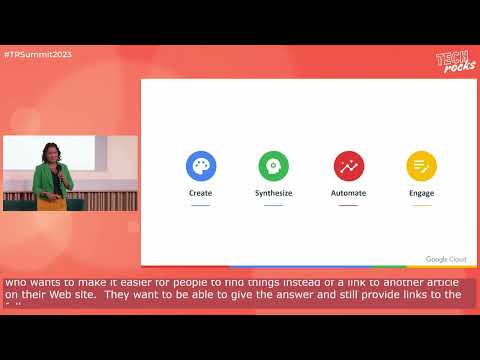
And then, of course, how do you increase engagement? using generative AI. I met with a client earlier who wants to make it easier for people to actually find things instead of just a link to another article that's on their website. They want to be able to just give the answer and still provide links to the full document. Wouldn't we all love that? Wouldn't it be great if we didn't have to keep hitting agent when we actually call the chatbot? Because I know that most of you in the room, including myself, we hate having to go through an IVR. So how could we change that kind of experience to make things more helpful? So we've seen, especially since the beginning of the year, with the economic changes all over the world, that there is a convergence of these forces, economic challenges, but also higher expectations. How many of you here have used ChatGPT? All right. Okay. All right, now, how many of you have used BARD? All right, we need to increase that by the end of the day, okay?
Especially with Gemini being out, I want all of you to test it and then feed back to the Google team and let us know if it's good. But I apologize if French support is not there yet. It's coming. But test it in English and then tell me if it's good. And so... What we've seen, that's part of the change in consumer behavior. We are consumers of all of this technology. Whether or not we get to use this technology at work is another thing. So remember when smartphones came out? And companies were struggling because we all liked using our smartphones, but our office phones and our office systems were terrible. And so then they had to figure out what mobile device management was. How do we actually create better experiences with our work systems so that employees don't just use their personal systems for work? We are at the same point right now with AI. A lot of people started to use ChatGPT. Lots of people are using BARD. But if you're not thinking, because of this change in consumer behavior, about how to create a safe, trusted, and private way for people to use and test these new generative AI tools,
You risk having them putting your company data outside because you know why? We're humans. We're always going to find something that makes it easier to do our jobs. We're always going to do that. And the reason? Because we want to save time. If you think of nothing, use AI to save time. Because our approach is thinking of AI for growth, thinking of AI for efficiencies, and thinking about AI for the future. Remember I said earlier, all these C-level people, they're struggling. How do we actually get started? There's so many things. Because it's not about everything. It's about being very specific about the thing that you're trying to do. And so when I said, We all try to save time. So time savings can be for growth, growing revenue, getting better engagement, right? Keeping someone actually longer so that you can actually tell them who you really are as a business, not just that particular shirt you're selling, not just the book, not just the car, but what is the full experience supposed to be?
Efficiencies. As a developer, imagine getting to test code much quicker, right? Creating that kind of a flow where you can have pair programming. with an AI versus just pair programming with a person. Those efficiencies matter, right? And then, of course, what is AI for the future for you as a business? What is AI for you for the future just as an individual? What kind of tools do you want to be using? What kind of tools do you want to offer someone who might be coming into your team and coming into your company and working for you? All of those things matter. What we've seen in talking to all of these different industries and companies globally is that these are the types, these are the top use cases we found that have delivered value. Make sure it goes. There we go. So to make complex data more easily accessible, more intuitively accessible, especially from a document and research perspective, every time I speak to capital markets, you know, people who are in the capital market space, lots of documents.
They have to look and read through so many different documents about derivatives, you know, what's happening with this particular crop yield, you know, which countries, which geographies do I buy a lot of these things from? What's going to happen to, if I buy this and invest this in, say, South America, Is there going to be a yield in, unfortunately, you know, with the conflict that we've had, there's been a downturn in some of the produce and some of the grains that are coming out from that part of the world. So what's this mean for all the markets? All of that kind of data is really difficult to sift through as a person. But with... AI and especially generative AI, you can change the way people experience that kind of data and that kind of research. The other aspect that we found is a lot on creation. So code development fits into here as well. How quickly can we actually make things? And how do we actually make these online interactions much easier? Like I said, no more agents. I can just ask the question, get an answer, see where my documents are. And then, of course, this is the content creation piece.
I was ahead of myself there. But the content creation is not just about marketing use cases. It's also about developer experience. It's also about code generation. And all of this needs to be in a secure, trusted, and private way. Now, of course, I'm talking about it from a Google Cloud side. Obviously, I'm going to say that our platform is trusted, private, and secure. Okay, so I'll start with that. But here are some of the statistics we found, having talked to customers, especially since earlier this year, and we've been tracking which use cases have had the best outcomes. At the time. And this has now obviously increased or decreased depending on the way you've designed your AI experience and your AI use cases. But the key thing is we found in order to reduce the hallucinations, in order to reduce the time it takes for you to make sure this AI is useful, is by having a human in the loop.
Some of you might have heard the term reinforcement learning through human feedback. This is exactly that. Even something as simple as a thumbs up or down when you create that new chatbot experience will help you actually learn if what you've designed is valuable or not. And we've also found, especially from a retail perspective, even with some of the economic changes, that if you actually design the right experience, it doesn't matter if you're more expensive. People will actually want to use you. How many of you would rather pay and use a premium product because of the experience. I know I would. Right? Because it's not just about making you feel good, it's that you actually get what you need in half the time. And then the quality is obviously the next thing. But that kind of experience will stay. We work with LVMH. And they are a very different market, right?
They are in the luxury brand market. And so people go there because they know they get the quality, but the customer experience is still really important to them. They have to stay one step ahead to be able to keep that kind of clientele. And so these are the sort of things that we are talking about. And how AI can actually help is... What people want to buy is one piece. How are people moving into the store? How do they move from thing to thing at the store? How do they change the experiences in the store? All of that uses a vision AI component, uses a traffic flow component. Those all matter. And now I want to walk through what reimagined customer experience can look like. And in this case, I'm going to walk you through because the video is really about Gemini. I've saved that for that. But GITS gives you an idea of what a new experience could be. Symbol Bikes is Google's company that we use internally to do our, so we name all of our stuff Symbol something. And so in this case, we have Symbol Bikes. And what we're going to show you is that Casey has decided, this was also a lot, by the way, during the pandemic, lots of people decided they were going to become real health fitness nuts.
And so that's why we actually picked this use case, because we saw an uptick in YouTube of people following athletes, triathletes, etc. And so in this case, Casey wants to get into triathlons, but also lives in New York and wants to be able to use a bike every day and also to be able to race with. So this is part of the generative AI thing. And if you haven't designed any of these generative AI chatbots, here's one of the options that's available through us that you can say, I just want it to answer from my domain. Meaning it's from your data, your knowledge base articles, your product catalogs, et cetera. You can answer the question. But then, this is the twist. How do you know whether or not the bike that you have is better than the bike that she has? In this situation, Casey goes, here's the one that I'm already using. Now, if you're a bike company, you already know your competitors. You already know your own bikes. But wouldn't it be cool if you could actually produce a table to actually show the differences between yours?
And your competitors? Oh, and you can. Right, in this one, because you could get the input, you could now do, and this is all generated just through generative AI. No one is sitting there and creating it because you've designed it and you've put in the data flows, all the data that you need. It's actually telling you, yep, here's the comparison between the bike that you have now and the new bike that we've produced. And it's even allowing, in this instance, for Casey to ask the question. So you can answer from your domain, like your website and your documents. You can create multimodal responses, but you can also have the option of turning on or turning off the AI-generated response. If you're worried about hallucinations, if you're worried about incorrect data, you can actually turn it off. In this situation, we have it on, where the AI is saying, to my knowledge, here's the difference between alloy bikes, etc. Now, abandoned cards.
That's a big issue, right? Most of us will add things to a card and then we go away. We may never come back. We may never buy anything. In this situation, Casey comes back. Casey comes back and says, I want to buy the bike. What should I do? And out of the box, you can actually have a transactional workflow for this conversation that you can just add. And it would do it. My favorite thing about this scenario is the time. Casey didn't give a time. Casey said any time after school. And because of a large language model already knowing what after school means in this situation in the US, It gave some time windows. But then Casey says, how about 2.15? Because Casey maybe doesn't have a child that goes to school like older kids. Maybe Casey only has a preschooler, and they finish at 12.30. So 2.15 works for Casey. And then Casey goes, yep, let's do it. I'm going to come into the store. I'm going to come and get the bike. Done.
Now, the delivering of new experiences is probably the biggest thing we've got. Lots of people are using it. We did a study with the Singapore government to get some use cases. They were funding 50 public sector use cases and 50 private sector use cases through their AI Trailblazers program. They actually received 100 submissions just on chatbots. And so they had to then reframe the things that they were looking for because everybody wants to have a better experience. And so that's like the number one thing that we're seeing because consumers, us as consumers, we want to be able to use AI to get better experiences. And so that was one of those things we noticed. But the assurances piece is the key. Make sure that you're allowing your teams to innovate using generative AI with secure, trusted, private sandboxes so they can experiment and actually build and have accuracy and security and all of those things built in. So here's a quick overview of our portfolio, starting from our generative AI tool.
tools, all the way through to it being built in our platform and our infrastructure, TPUs, GPUs, etc. So we fine-tuned our Vertex platform and our generative AI tooling to take advantage of the best technology that's there as possible. But all of this really only delivers value when it helps you and it helps your business and it helps your consumers and your customers. We support hundreds of models, including First party, third party, and open source models. Here are just some of them. You can see more on our website. And then, of course, we have what we've done with Gemini. And next week, there'll be more for you to learn about Gemini and Gemini Pro through Vertex. The key thing I want you to take away from here, so earlier, remember I said about using your data to do grounding so that you can reduce hallucinations? This is exactly that. Vertex is an end-to-end machine learning platform, and it also supports all the connections to different data sources.
A lot of the generative AI things that you saw today can be done through APIs. So it's nice, it's simple, it's clean. Now, establishing your brand voice. Everyone here has, we have our own tone, we have our own personalities, right? So how do you actually showcase that, especially for who you work for, or the brands that you represent, that kind of brand voice? That's all supported. So in this instance, you can see the example. I want a 75 word for this description. And then I want to be able to have these four different ways from a social media post or etc. And you know, earlier I mentioned with LVMH, theirs is going to be high quality and more of a luxury brand kind of feel, but they still want to attract different audiences. So how can you actually use generative AI to target even those and create the right kind of copies? This is an example of highlighting how generative AI, because of large language models, can make things faster for someone who is in the creative copy side to give their ideas and produce their ideas forward.
You've also seen things all about images. How do we produce better images, et cetera? Here are some of the things that we have through Imogen for image masking and editing. We also have StyleDrop for people who need the creative aspects, especially all the ad agencies and all the creative teams love this. All the folks I speak to in marketing and all of the marketing departments, they love using this tool because now they can actually show what's been in their minds creatively so much faster. I'm terrible at drawing. Right? I'm terrible at drawing. But now I can actually just type what I'm thinking about and what I want to show, and then I can actually use something like the AI to help me get my idea across. Architectural diagrams I draw very well because there's just boxes and arrows. But anything else, this is what I tend to use. And then of course, upscaling. That was one of the biggest requests we received from a lot of creatives who wanted to be able to upscale images so that they could actually use that and produce copies with it and potentially even brochures and products. So we support that.
And then of course, how do you know if an image is AI generated? Working together with DeepMind, we announced SynthID so that now you can watermark AI generated images as a business. Because of all the things that have been coming out on copyright. And of course, responsible AI. Google is all about building with AI, and responsibly. We actually shared back in 2018 our AI principles of what we would do and what we wouldn't do as a company. And so that's the core to all of the things that we actually build and develop. We've actually had a lot of clients as well as governments look at these and also adopt them. And so these are the things that you can do with this as well. You can actually create your own AI policies based on this. We've also made sure that you can implement responsible AI through Vertex in the platform because we have safety attributes and weights that you can also change based on your own risk profile as a company.
When we first started doing this, we had a risk profile that cybersecurity companies couldn't use because of the way threat actors actually use certain terms and wordings. But then we changed them so that through our own process and said, look, we need to allow our customers to be able to adjust this based on their risk profiles. And that's what we did. So you can actually specify for yourself low, medium or high based on what it is that you're trying to do. There are opportunities everywhere. So how you want to actually do this, and these are the four areas that we think you should consider if you want to change how you improve customer experience, if you want to change how you can search for data and do better analysis, if you want to improve your operations, all of these things matter because it will help us save time. Now, hopefully, The video will play. The next one. Can we play the video? Perfect. If I were to look at the foundational breakthroughs in AI over the past decade, Google has been at the forefront of many Of those breakthroughs.
Gemini is our largest and most capable model. It means that Gemini can understand the world around us in the way that we do. So not just text, but also code, audio, image, and video. Taylor used Gemini to search a large corpus of scientific papers for key information. We wrote a prompt. With its advanced reasoning capabilities, Gemini was able to distinguish between papers that were relevant to the study and those that weren't. I'm delighted to introduce AlphaCode 2, powered by Gemini. When we evaluate AlphaCode 2 on the same platform as the original AlphaCode, we solve almost twice as many problems. Gemini on its own has the ability to transform software development as we understand it. Based on their design, which of these would go faster? The car on the right would be faster. It is more aerodynamic. But safety and responsibility has to be built in from the beginning. And that has oriented us to be both bold and responsible together. Developers and enterprise customers are going to figure out really creative ways to further refine our foundational models.
Gemini will be available in three sizes. Gemini Ultra, our most capable and largest model for highly complex tasks. Gemini Pro, our best performing model for a broad range of tasks. And Gemini Nano, our most efficient model for on-device tasks. It's been a monumental engineering task, which has been very challenging, but also very exciting. Thank you for that. And I believe there's a Q&A section now. Yes? You want me to come with you, or it's okay for you? Come and sit with me on the couch. Let's take a... Oh, yeah. Thank you. Thank you for welcoming me. Thank you. So we have, I think we have 10 minutes of Q&A session. Yes. It's okay for you? Of course. So we know the mechanics. You raise your hand and then we come. Hi. In the simple example, I thought you said that we were able to limit the responses to data from your own domain. How do you manage to do that?
Inside the design flow of Vertex, you can upload structured and unstructured data and then allow the generative aspect of it to answer from that without actually needing to turn on an actual AI generator. So it would just out of the box, having cataloged your, let's say, your knowledge base article on customer service, and then you could basically on a chat interface ask questions and it would actually just learn from that document how to actually have the conversation because there's already a large language model at the end understanding the query that's coming in. Yes, we have a cartoonist. Oh, there we go. It's just for you. Yes, I am wearing Google colors. There is a dress code. Yes, I am wearing Google. I would like that picture, actually. We'll give you the picture after. Yeah. That's even better if it was AI generated. It could have been. Another question? Or Caroline?
Wow, no questions is a good thing. Oh, there you go, that's one. In the middle. As long as nobody's got an apple or an orange and throws it at me, I'm doing okay. Thank you very much for your talk. In the presentation of Gemini for the smaller models, the smallest ones, it said that it's good for small devices, etc. So it means we are able to deploy Gemini on-premise? Yes. Cool. Thank you. Very quick answer. Thank you, Caroline. Another question? Yes, I can hear you. Yes. You said that you are responsible about the future in the generative AI. How do you feel about regulation, future regulation can happen in the future about it?
And if you will work on it? With the government, different government, or United States, or in the France, about all of this regulation? So we have, we actually have a team that has been meeting with different governments as well as being part of the AI summit that was held at Bletchley Park. So, you know, where all of the teams, like, you know, the French government team was there, etc. All of the researchers were there. So we are working very closely with all of the global bodies around regulation and AI and what that means. And in fact, this is also my personal opinion. I think we should have a policy, not a policy. I think we should have guidelines on data regulation. And here's why. We all use so many free platforms, right? Social media platforms, for example, and a lot of our children don't think about their own data going into those things. So I think that if we were to educate more people around data and how it's used, Europe is a lot more advanced, especially around things like GDPR, right?
Being able to remove your own data. So I think the more we educate and the younger we start with educating them on data and what it means, the better I think we will be. Did that answer your question? I think so. Another one? Last one, maybe? Anyone? No? So I think it's okay. Yes! Thank you so much, Caroline. Thank you. Thank you. Thank you for having me. Thank you so much.